 Buying disposable coveralls off the shelf is a bit like handing your crew a one-size-fits-all raincoat and hoping the wind doesn’t change direction. For a business buyer, the real money isn’t only in the garment. It’s in the fit, the fabric, the compliance file, the carton, and the name printed on the neck label. That’s where OEM and ODM services come in.
If you’re sourcing for a safety distributor, a contractor, a healthcare group, or a private-label brand, you already know disposable coveralls can be a commodity. They can also be a differentiator. The difference usually comes down to how well the manufacturer can follow your requirements, or how smartly they can help you create them.
OEM: You bring the blueprint. The factory brings the execution.
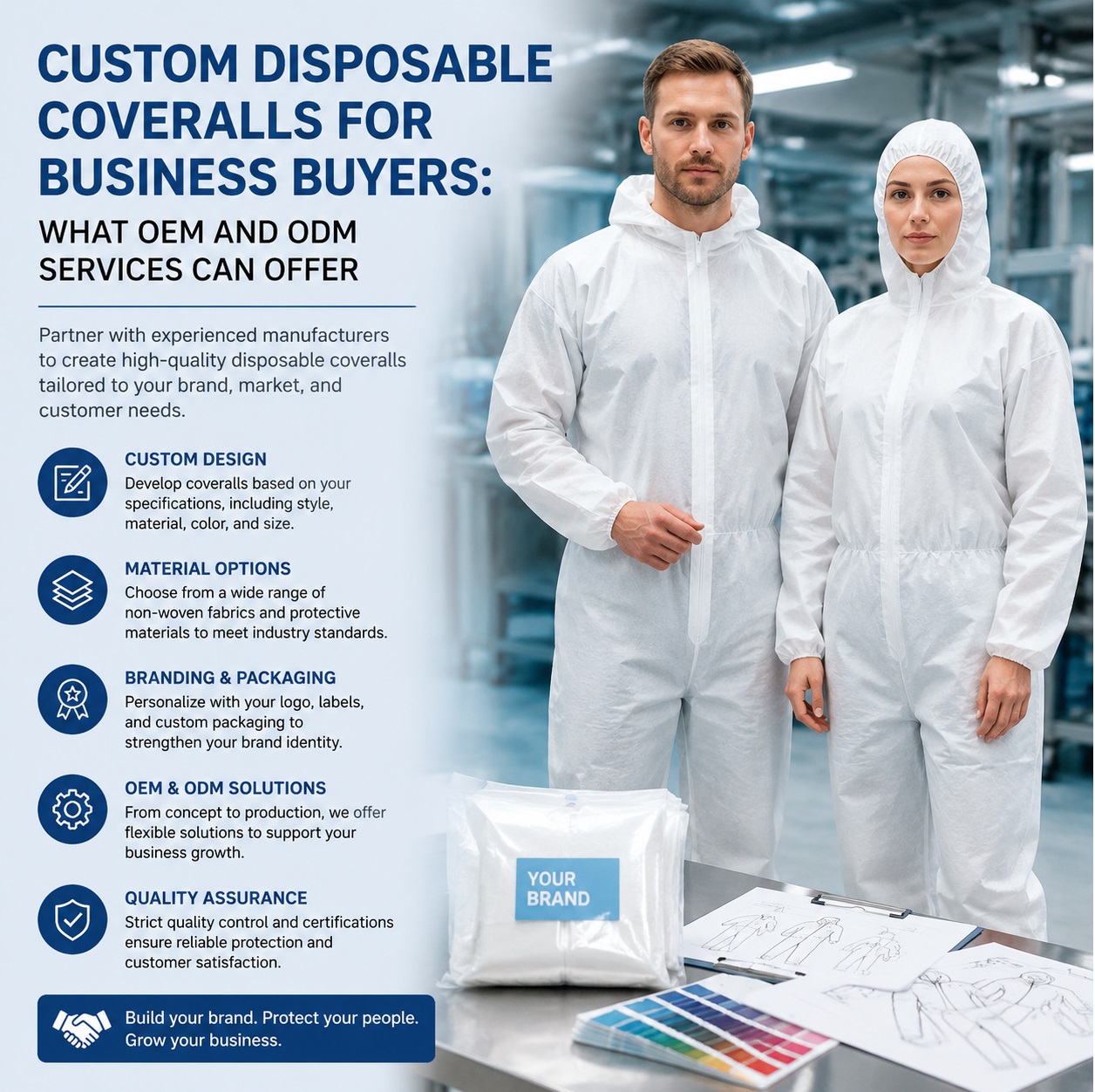
With OEM, you define the coverall. You choose the fabric: PP, SMS, or microporous film laminate. You set the weight, often measured in GSM. You decide whether the seams are serged or taped. You pick the hood, the zipper, the storm flap, the elastic wrists and ankles, the waist, the booties, and the color. You approve the logo placement, the size labels, the poly bag, the carton marks, and the barcode. The manufacturer builds to your spec, under your brand.
That level of control matters when your customers expect a specific fit or when your market demands a particular certification. It also matters when you want to avoid looking like every other catalog page. A custom coverall can carry your logo, your size system, your packaging language, and your quality promise. The factory becomes an extension of your operation, not just a source of generic stock.
ODM: You bring the market. The factory brings a proven design.
ODM flips the starting point. Instead of designing from zero, you tap into a manufacturer’s existing coverall platforms. These are already developed, tested, and refined. You can often customize colors, labels, packaging, and size ranges without paying for a full new pattern or a long development cycle. For distributors testing a new category or buyers who need speed, ODM can be the faster route to a private-label product.
The trade-off is customization depth. If your brand needs a very specific fabric, seam, or feature set, OEM gives you more room. If you need a reliable product with your logo and packaging in weeks rather than months, ODM may be the practical answer. Many suppliers offer a hybrid: start with an ODM base, then modify the details that matter most.
What should business buyers ask before signing off?
Ask about the fabric first. Not all SMS is the same. Not all microporous film is the same. GSM alone doesn’t tell the full story. You want data on tear strength, burst strength, particulate filtration, liquid penetration, and anti-static performance if relevant. For Type 5 and Type 6 coveralls, ask for test reports tied to EN 13982-1 and EN 13034. If the product claims CE under EU 2016/425, get the documentation. If it’s for medical or cleanroom use, ask about ISO 13485, cleanroom processing, and any FDA or equivalent registrations the factory actually holds. Don’t accept vague assurances. A serious OEM or ODM partner will have the paperwork ready.
Then look at construction. A coverall is only as good as its seams and closures. Serged seams are common for general protection. Taped seams cost more but reduce particle and liquid ingress. Elastic wrists and ankles keep the garment in place. A storm flap over the zipper adds protection. Thumb loops, boot covers, and two-way zippers can make a real difference on the job site. These details drive worker acceptance. If the coverall tears, binds, or overheats the wearer, it won’t get used correctly. That’s a safety problem and a return problem.
Branding and packaging deserve more attention than most buyers give them. Custom printing on the chest, back, or sleeve turns a disposable item into a walking advertisement. Printed neck labels and size labels reduce confusion in the field. Retail-ready poly bags, multilingual instructions, and sturdy cartons help distributors move product through their channels. If you sell online, barcodes and carton labels need to match your warehouse system. OEM and ODM services can handle all of this, but you have to specify it early.
Cost is a conversation, not a number. Fabric weight, seam type, accessories, printing, packaging, and order volume all move the price. A lower GSM coverall may look cheaper per unit, but if it fails early or gets rejected by workers, the real cost is higher. A slightly heavier fabric with better seams can reduce complaints and returns. Good suppliers will help you find the right balance for your market instead of pushing the cheapest option.
Lead time and quality control can make or break a program. Ask how long samples take, how production is scheduled, and what inspection process is used. AQL standards, in-line checks, and third-party inspection options are fair questions. If your order is urgent, confirm capacity before you promise your customers a delivery date. If your order is seasonal, lock in raw material early. OEM and ODM partnerships work best when both sides communicate openly about forecasts, changes, and problems.
The real value for business buyers is leverage. With OEM, you get a product built around your brand and your requirements. With ODM, you get a faster path to market with proven designs. Either way, you stop competing only on price. You compete on fit, compliance, packaging, worker satisfaction, and supply reliability. That’s a stronger position for any distributor, contractor, or private-label brand.
If you’re ready to move beyond stock coveralls, start with a clear brief. List your fabric, weight, size range, features, certifications, packaging, and target price. Ask for samples and documentation. Compare factories on communication and consistency, not just quotes. The right OEM or ODM partner will do more than sew coveralls. They’ll help you build a product line your customers ask for by name.