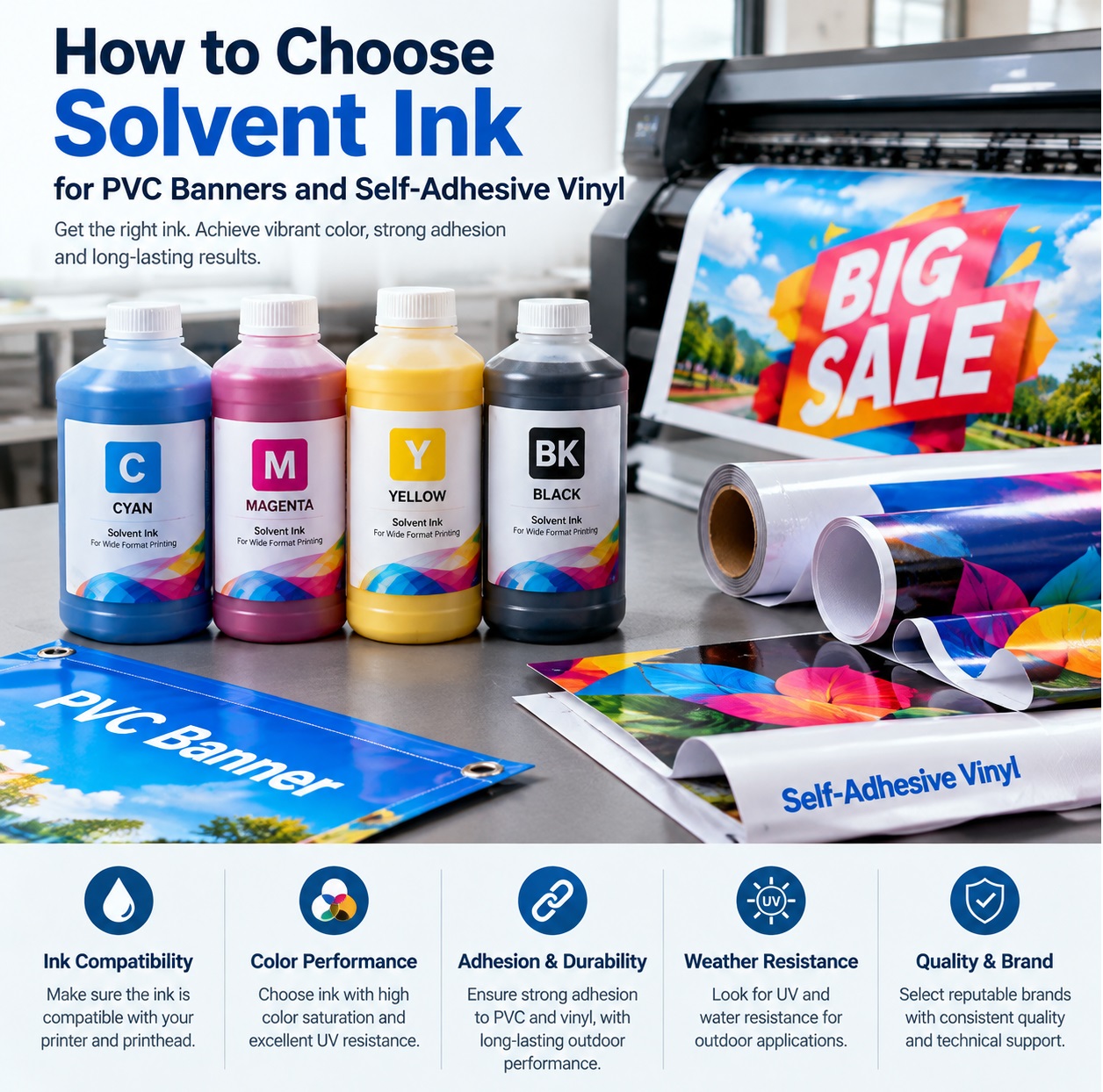
 A banner that curls like a potato chip after one weekend in the sun is not a mystery; it is usually an ink problem. The same goes for self-adhesive vinyl that lifts at the edges, cracks along a fold, or loses half its color before the lease is up. If you print on PVC banners and adhesive vinyl for a living, the ink you load is not a minor supply decision. It is part of your reputation.
Solvent ink is not one product. It is a family. Eco-solvent, mild solvent, and hard or true solvent inks all behave differently. They smell differently, dry differently, and punish mistakes differently. The right choice depends on your printhead, your substrates, your customer’s expectations, and your shop’s ventilation. Price is the last thing you should compare, not the first.
Start With the Printhead, Not the Price Tag
Your printer’s printhead is the most expensive part of the conversation. Every printhead has a designed viscosity range, droplet size, and chemical tolerance. An ink that works beautifully in a Roland, Mimaki, or Mutoh eco-solvent machine may destroy a Ricoh, Konica Minolta, or Spectra head in an industrial printer. This is not a place for guesswork.
If you use OEM ink, compatibility is mostly handled. If you use third-party or bulk ink, demand proof. Ask for the exact printhead compatibility list, ICC profiles for your printer and RIP, and a batch-specific technical data sheet. A serious supplier will have those documents ready. A broker who says it works on everything is selling you a future repair bill.
Then Match the Ink to the Substrate
PVC banners and self-adhesive vinyl are not the same animal. Banner material is usually plasticized PVC. It stretches, folds, and gets tied to fences. The ink has to stay flexible. If it dries too hard, a simple fold can create a white crack line. If it bonds poorly, the print will rub off when the banner is rolled or handled.
Self-adhesive vinyl brings its own problems. Calendared vinyl, cast vinyl, removable adhesive, permanent adhesive, and laminated films all react differently. You need an ink that adheres without crawling, without edge curl, and without turning the liner into a wrinkled mess. If you laminate, the ink must be fully cured before the film goes down. Otherwise you get bubbles, silvering, or delamination that shows up after the job leaves the shop.
Eco-solvent ink is often the practical choice for everyday banners, decals, and vehicle graphics that will be laminated. It has a milder odor, works in many office-style print environments, and offers good color. Its outdoor life is decent when paired with quality media and lamination. Mild solvent ink sits in the middle, with faster drying and stronger durability. Hard solvent ink is the heavyweight. It delivers aggressive adhesion, fast drying, and long outdoor life, but it demands ventilation, proper media, and a shop that understands chemistry. It is not the ink for a closed room with a desk fan.
Look at the Job, Not the Catalog
A three-month indoor banner for a trade show does not need the same ink as a three-year construction site sign. A removable wall decal does not need the same ink as a fleet of trucks. Ask what the print must survive. Sun, rain, wind, abrasion, cleaning chemicals, and temperature swings all matter.
If the job will be laminated, you have more freedom. Lamination adds UV and scratch protection, so a good eco-solvent or mild solvent ink can often meet the durability requirement. If the job will be unlaminated and left outdoors, you need a tougher ink with proven UV resistance and strong adhesion. If the vinyl will be stretched or curved, flexibility becomes non-negotiable. If the banner will be folded and shipped, cracking resistance matters more than a tiny difference in color gamut.
The Numbers That Actually Matter
Ink cost per liter is a vanity metric. What matters is cost per square meter of finished, sellable print. That number includes ink yield, cleaning cycles, wasted media, reprints, and clogged printheads. A cheap ink that costs half as much but causes one head replacement per year is not cheap. It is a donation to your printer technician’s vacation fund.
Look for drying time, adhesion, scratch resistance, color consistency, and shelf life. Check how the ink behaves when the printer sits idle overnight or over a weekend. Does it need aggressive purging? Does it clog the capping station? Does it smell like a chemical spill? These details decide whether you make money or babysit the machine.
Test Like You Mean It
Never commit to a full production run based on a supplier’s sample print. Get a sample bottle or cartridge. Print a real test file on the exact PVC banner and self-adhesive vinyl you use. Include gradients, fine text, solid blocks, and skin tones. Let the print cure for at least 24 hours. Then try to destroy it.
Do a tape test for adhesion. Rub it with your thumb and a fingernail. Fold it, crumple it, and stretch it. Put a laminated sample and an unlaminated sample side by side. Spray it with water. Leave it in the sun if you can. Check for edge curl, color shift, cracking, and ghosting. If the ink fails on a sample, it will fail on a customer’s job. If it passes, you have data instead of a sales pitch.
Ask the Supplier These Questions
What printheads is this ink built for? Do you provide ICC profiles for my printer and RIP? Is there a batch number and certificate of analysis? What is the shelf life and storage temperature? What happens if the ink causes a clog or a failed print? Can you support me with technical help, not just an invoice? How consistent is the next batch?
A good ink supplier will ask you questions too. They will want to know your printer model, your substrates, your lamination process, and your typical jobs. If they do not care about those details, they do not care about your business.
Red Flags to Avoid
Be suspicious of any solvent ink that is dramatically cheaper than everything else, has no technical documents, no batch traceability, and no profiles. Universal is a warning word. So is same as OEM with no evidence. Strong solvent ink can be a great tool, but it needs respect. If the odor makes your eyes water and your ventilation is a window, you have the wrong ink for your shop.
The Bottom Line
The best solvent ink for PVC banners and self-adhesive vinyl is the one that protects your printhead, sticks to the media, survives the customer’s environment, and lets you price the job profitably. Start with printhead compatibility. Match the ink to the substrate. Test before you buy. Then choose a supplier who treats your production floor like their own.
Your customers do not see ink. They see a banner that still looks sharp after a season in the sun, or a decal that peels off cleanly when the promotion ends. Choose the ink that makes that happen, and you will spend less time reprinting and more time selling.



















 Buying